Magnetism and Electromagnetism🔗
Beginner
This article is in the Circuit Foundations topic. It builds on Current and AC vs DC. No other prior knowledge required.
Wrap insulated wire around an ordinary steel nail, connect the two ends to a battery, and the nail picks up paper clips. Disconnect the battery and the clips drop. There's no magnet anywhere in the setup: just a nail, some wire, and a battery.
Two ideas explain where the magnet came from:
- Magnets surround themselves with a field. It has a north pole and a south pole, it can be mapped with lines, and like poles repel while unlike poles attract.
- Electricity and magnetism are the same force. A current makes a magnetic field, and a changing magnetic field makes a voltage. Those two facts run electromagnets, motors, generators, transformers, and, in the end, radio.
One of Four Forces🔗
Physics recognizes four fundamental forces: gravity, the strong and weak nuclear forces (which only act inside atoms), and electromagnetism. The attraction between electrons and the nucleus in Conductors, Insulators, and Semiconductors is electromagnetism, and so is the pull of a fridge magnet. They look like different forces, but they're two faces of one, and the second half of this article shows how they connect.
Idea One: Magnets and Their Fields🔗
The space around a magnet, where its force can be felt, is its magnetic field. The field can't be seen, but it can be mapped: iron filings sprinkled around a magnet line up into curves, and a small compass placed anywhere in the field points along them. Those curves are drawn as field lines.
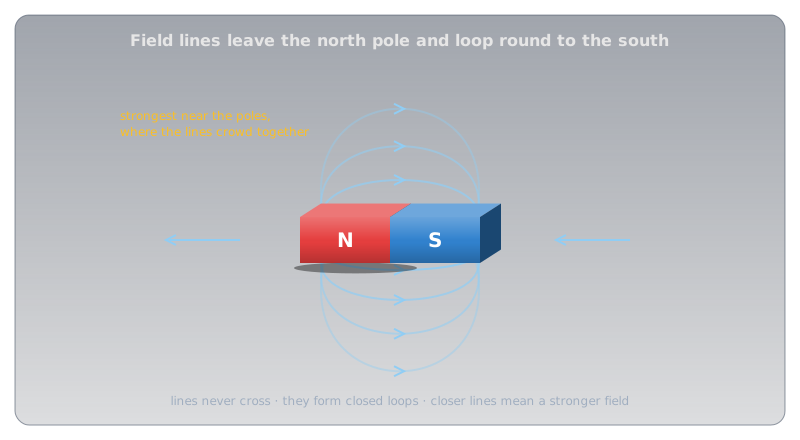
Field lines follow a few rules:
- They leave the north pole and enter the south pole (outside the magnet), and run on through the magnet to form closed loops.
- They never cross.
- They crowd together where the field is strong, which is why a magnet is strongest at its poles.
Poles always come in pairs. Cut a bar magnet in half and you don't get a separate north and south: you get two smaller magnets, each with both poles.
Like Poles Repel, Unlike Poles Attract🔗
Bring two magnets together and their fields interact. A north pole facing a south pole pulls the magnets together; two of the same pole push them apart.
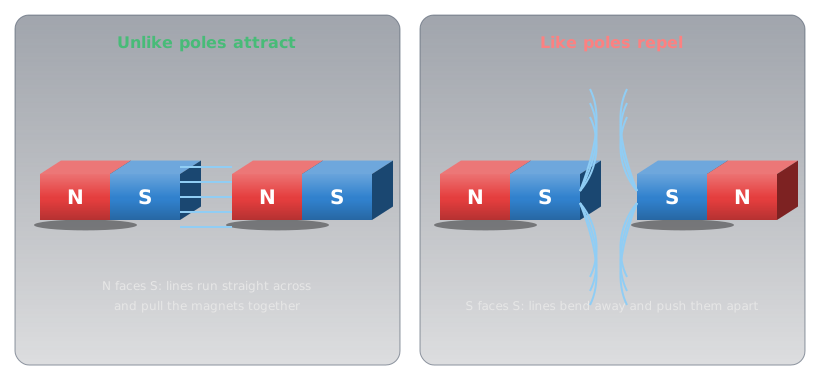
That rule hides a twist. A compass needle is a small magnet, and the end marked N points north. Since unlike poles attract, the pole of the Earth near the geographic North Pole must be a magnetic south pole. The names are older than the physics.
Kinds of Magnets🔗
Magnets come in three broad kinds, defined by whether their magnetism lasts:
-
Permanent magnets
Keep their magnetism indefinitely. Ferrite (ceramic) magnets are cheap and common in fridge magnets and loudspeakers; alnico (aluminium, nickel, cobalt) was common in older equipment; neodymium magnets are the strongest ordinary magnets made.
-
Temporary magnets
Materials like soft iron and steel become magnetic while they sit in a field, then mostly lose it when the field is taken away. A nail stuck to a magnet can pick up a paper clip of its own.
-
Electromagnets
A coil of wire carrying current, usually around an iron core. Their strength can be turned up, down, or off with the current. The second half of this article explains them.
How Strong Is a Field?🔗
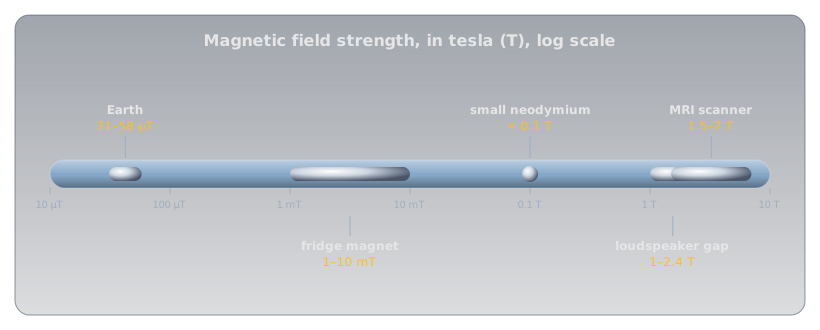
Field strength is measured in tesla (T), a large unit: everyday fields are usually given in millitesla (mT) or microtesla (µT), using the prefixes from Metric Prefixes and Units.
Idea Two: Electricity and Magnetism Are One Force🔗
The connection between electricity and magnetism was found by accident. In 1820, the Danish physicist Hans Christian Ørsted noticed that a compass needle swung when he switched on a current in a nearby wire. A current makes a magnetic field.
A Current Makes a Field🔗
The field around a straight wire forms rings centred on the wire. Its direction follows the right-hand rule: point your right thumb along the conventional current (Current), and your fingers curl the way the field circles.
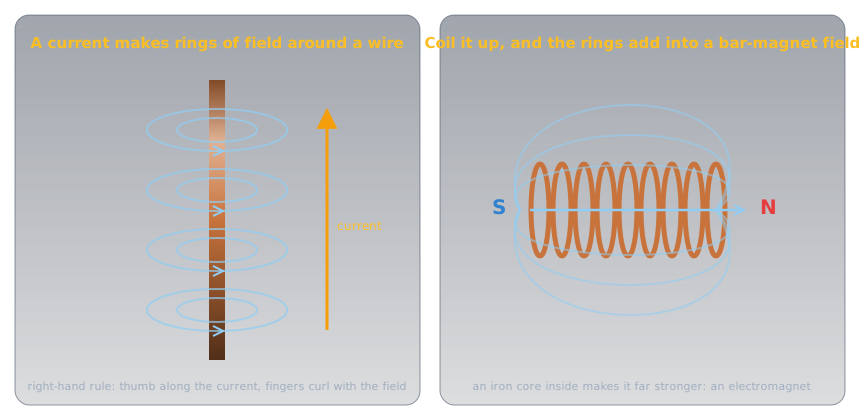
One wire's field is weak, but winding the wire into a coil adds every turn's rings together, and the result is a field shaped exactly like a bar magnet's, with a north end and a south end. Put an iron core inside and the iron's own magnetism lines up with the coil's field and multiplies it many times over. That's an electromagnet, and it's the nail puzzle solved.
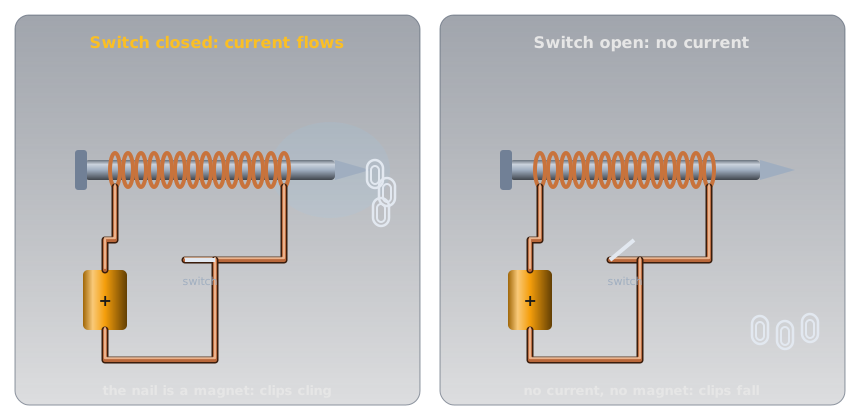
The magnet was the current all along. The coil of wire made a field the moment current flowed, the steel nail concentrated it, and opening the switch stopped the current and the field together. More turns, more current, or a better iron core all make an electromagnet stronger.
Electromagnets are everywhere a magnet needs to be switched:
- Relays use a small current in a coil to pull a switch closed, so a small signal can control a large load.
- Motors use electromagnets pushing against permanent magnets (or each other) to turn a shaft.
- Loudspeakers push a coil back and forth against a permanent magnet in time with the audio signal.
A Changing Field Makes a Voltage🔗
In 1831, Michael Faraday found the reverse: a magnetic field can push a current, but only when it's changing. Move a magnet into a coil and a meter connected to the coil swings. Hold the magnet still and the meter reads zero. Pull it out and the meter swings the other way. This is electromagnetic induction.
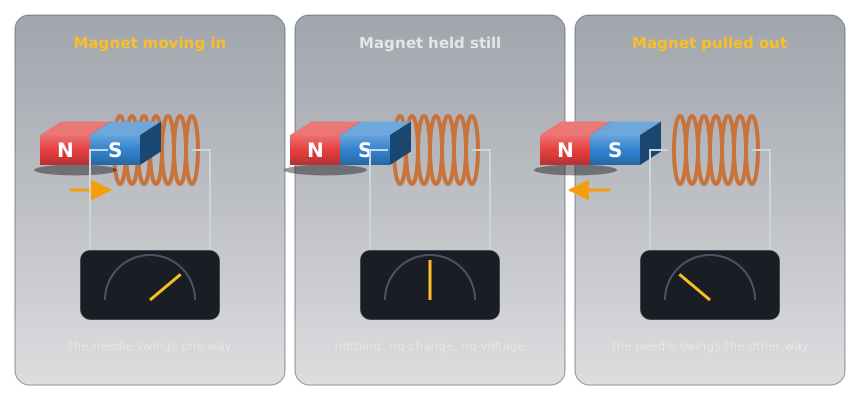
Induction is what makes a generator work. AC vs DC showed a loop turning between magnet poles: the field through the loop keeps changing as it turns, so a voltage keeps being induced, first one way and then the other. That's alternating current.
Transformers🔗
Induction also lets two coils share energy without touching. Wind two coils on one iron core and feed AC into the first (the primary). Its constantly changing field circulates through the core and induces a voltage in the second coil (the secondary).
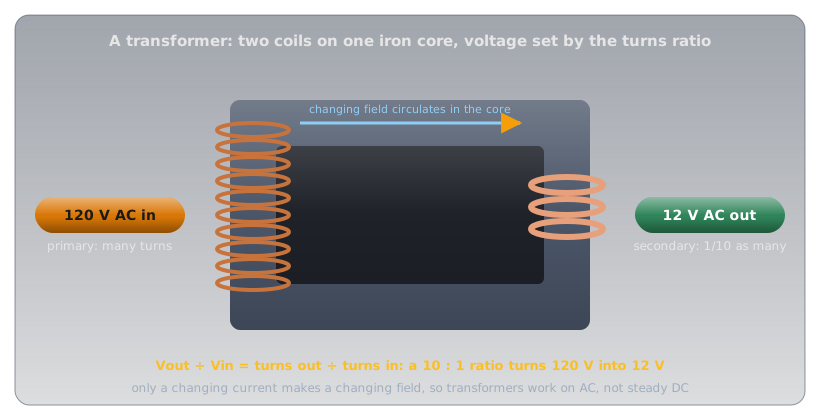
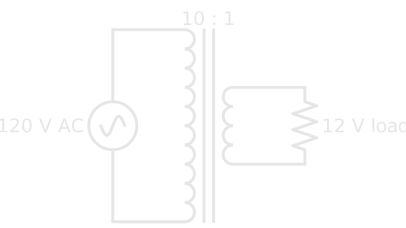
Every turn of each coil sees the same changing field, so the voltages are in the same ratio as the number of turns:
A transformer with ten times as many turns on its primary steps 120 V down to 12 V. Turn it around and it steps voltage up instead, which is how the grid reaches the high voltages that Ohm's Law and Power showed are needed for long lines. A steady DC current makes a steady field, which induces nothing, which is why transformers only work on AC.
From Fields to Radio🔗
A current makes a magnetic field; a changing magnetic field makes a voltage. In 1865, James Clerk Maxwell worked out that changing electric and magnetic fields can keep generating each other and travel through space on their own, at the speed of light. In 1887, Heinrich Hertz, the man the unit of frequency is named after, made and detected those waves in his laboratory. They're radio waves: electromagnetism set loose from the wire.
Safety: Strong Magnets🔗
Small, powerful magnets, like the neodymium magnets used in craft projects and magnet sets, are a real hazard around children.
Swallowed Magnets Are a Medical Emergency
Health Canada warns that swallowing small, powerful magnets can cause severe injury or death, with children under 10 most at risk. Two or more swallowed magnets can attract each other through the walls of the intestines and tear them. Keep loose small magnets away from children, and get medical help immediately if one may have been swallowed.
Larger neodymium magnets carry their own risks.
Pinches, Shards, and Electronics
Strong magnets snap together hard enough to pinch skin painfully and can shatter into sharp shards when they collide. Magnet suppliers also warn to keep them away from pacemakers and other implanted medical devices, and from the magnetic stripes on cards.
Practice🔗
1. Which Way?
A magnet's north pole is brought near another magnet's north pole. What happens?
Solution
They repel. Like poles push apart; only unlike poles (north and south) attract.
2. Cutting a Magnet
A bar magnet is cut in half across its middle. How many poles does each half have?
Solution
Two. Each half is a complete magnet with its own north and south pole; poles always come in pairs.
3. A Stronger Electromagnet
Name three ways to make the nail electromagnet stronger.
Solution
Use more turns of wire, more current (within what the wire and battery can safely handle), and a better iron core. Each one increases the field.
4. Still Magnet
A strong magnet sits motionless inside a coil connected to a meter. What does the meter read, and why?
Solution
Zero. Induction needs a changing field. A stationary magnet makes a steady field, which induces no voltage.
5. Turns Ratio
A transformer has 600 turns on its primary and 30 on its secondary. With 120 V AC on the primary, what's the secondary voltage?
Solution
\( 120 \times 30 / 600 = 6\ \text{V} \) AC. The ratio is 20 : 1, so the voltage steps down twenty times.
6. Why Not DC?
Why won't a transformer step down the 12 V DC from a car battery?
Solution
Steady DC makes a steady magnetic field in the core, and a steady field induces no voltage in the secondary. A transformer needs a changing current, which is why it works on AC.
Quick Recap🔗
-
Fields and poles
Field lines leave north and enter south, never cross, and crowd where the field is strong.
-
Attract and repel
Unlike poles attract; like poles repel. Poles always come in pairs.
-
Kinds of magnets
Permanent (ferrite, alnico, neodymium), temporary (soft iron), and electromagnets.
-
Current makes a field
Ørsted, 1820. A coil with an iron core is an electromagnet.
-
Changing field makes a voltage
Faraday, 1831. Induction runs generators and transformers.
-
Transformers
Voltage ratio = turns ratio. AC only.
What's Next🔗
With electricity and magnetism joined, Series and Parallel Circuits returns to building real circuits from several components.
Further Reading🔗
Reference
- Orders of Magnitude (Magnetic Field) — Wikipedia — the field strengths used in this article
- Magnet Safety — Health Canada — the risks of swallowed magnets
Deep Dives
- Electromagnetic Induction — Wikipedia — Faraday's law and how generators and transformers use it
- Transformer — Wikipedia — cores, windings, and the turns ratio
Related Articles
- AC vs DC — the generator that induction makes possible
- Ohm's Law and Power — why transformers step the grid up to high voltage
- Current — the conventional current direction the right-hand rule uses